
Event Details
Sunday, December 7, 2025, 4:00pm
Catherine Cassidy Gallagher Great Hall, GBPAC
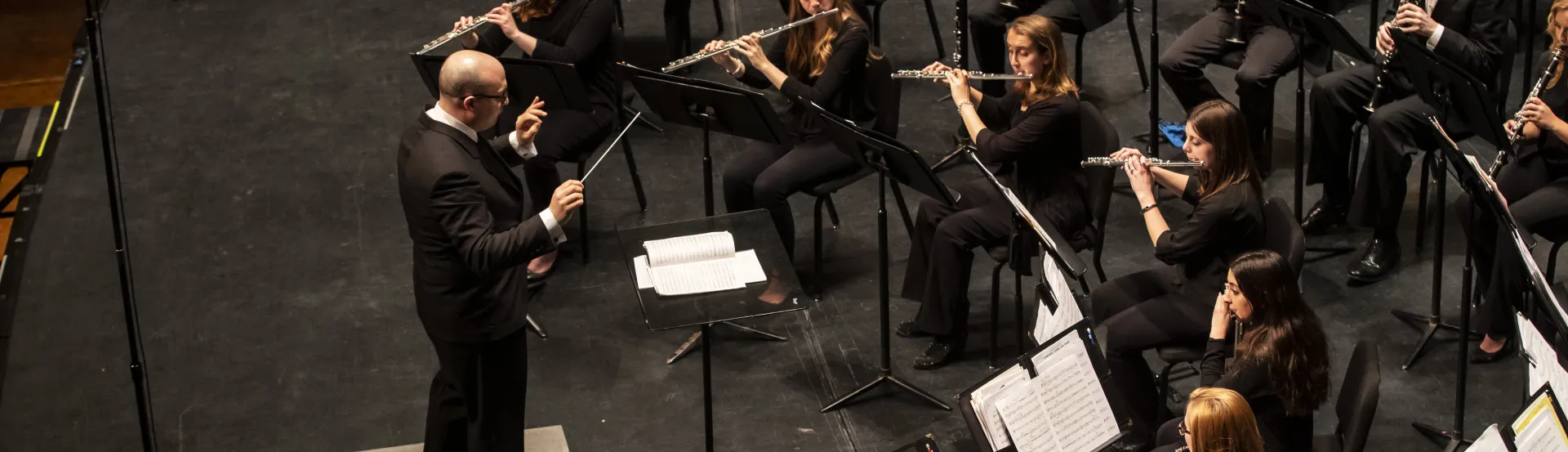
UNI Symphonic Band
Justin J. Mertz, conductor
Timarie LaFoy, graduate associate conductor
I. Pon Farr
II. Mind Meld
III. Vulcan’s Forge
Timarie LaFoy, graduate associate conductor
INTERMISSION
1. A Cowboy’s Life
2. Goodbye, Old Paint
3. Bury Me Not
4. Rye Whiskey
- Personnel
-
Flute
Grace O’Keefe*
Katie Flaherty
Aldo Escalera
Caleb Little
Janie OwensOboe
Kennedy Kisling
Aveinda Rusk*Bassoon
Carter Danielson
Ian Burrack*
James SchaferClarinet
Maddy Christof
Elliana Minter
Mackenzie DeRonde
Lance Schmitt
Riana Kraft*
Meredith Moore
Gabriel Jesse*
Taylor BraunSaxophone
Anthony Bernard
Carter Seber
Kara McGonegle*
Hope Jones
Sienna Becker
Braxton NachtigalTrumpet
John Broulik
Ale Cabello*
Blake Fullmer
Andrew Dutcher
Ian Hanks
Josh NeasHorn
Alyssa Haynie
Rori Snethen*
AJ Shively
Aurelia ZylstraTrombone
Noah DeVore
Camden Bennett
Jackson Elliott*
Maddy White
James Landeros
Sam Hoffmann
Michael ShonrockEuphonium
Riley CapperTuba
Logan Lubahn*
Zachary SmithPercussion
Angelina Frank
Owen Ruth
Emmett Jordan
Reece Hoffman
Benjamin Grim*
Brayden DeVries+
Sean Middleton+Celesta
Chloe Berns-Schweingruber+Librarian
Jenny Valenzuela* = Section Leader
+ = Member of the UNI Wind Ensemble Assisting with Tonight’s Performance
- About the Program
-
Festal Scenes
Festal Scenes is based from four folk songs that are native to the Aomori Prefecture, the most northern province on Japan’s main island: Jongara-jamisen, Hohai-bushi, Tsugara-aiya-bushi, and Nebuta-festival. Yasuhide Ito’s inspiration for composing the piece was based off text from a letter he received from a friend, “...everything seems like Paradise blooming all together. Life is a festival, indeed.” These folk songs have strong historical and traditional ties to the Aomori Prefecture and give an aural snapshot of the sense of pride and honor citizens native to this prefecture have for their homeland. Festal Scenes (1986) was commissioned and premiered by the Ominato Band for the Japan Maritime Self Defense Force on October 28th, 1986. The American premiere of the piece was at the joint Japanese Band Association and American Band Association Convention in July of 1988 and was performed by the Illinois Concert Band. The United States Air Force Band, under the direction of Lieutenant Colonel James Bankhead, performed the second premier of the piece in July of 1988 as the WASBE Convention held in Washington D.C.
- Program Note by composer
Lagan Love
The music of Luigi Zaninelli (born 1932) is known to performers and audiences around the world for works that excite the senses and stimulates the mind. Following high school, he was brought to he Curtis Institute of Music by Gian-Carlo Menotti. At age 19, he was sent to Italy by the Curtis Institute to study composition with the legendary Rosario Scalero (the teacher of Samuel Barber and Menotti). During his career, Mr. Zaninelli has served as composer-in-residence at the University of Calgary and the Banff School of Fine Arts. Since 1973, he has been the composer in residence at The University of southern Mississippi. With more than 300 published works to his credit, Mr. Zaninelli has been commissioned to compose for all mediums, including opera, ballet, chamber music, orchestra, band, and chorus. He also has composed several movie and television scores.
"While in Dublin, Ireland, for the world premiere of my Five American Gospel Songs for Soprano and Orchestra, I heard a melody of such extraordinary beauty that I felt compelled to set it. Its haunting mystical melancholy was unlike anything I had ever heard. It continues to beguile me."
- Program Note by composer
Vulcan
Vulcan (2014) for Concert Band was commissioned jointly by Ann Arbor High School band directors David Leach (Pioneer), Stephen Roberts (Huron) and Jason Smith (Skyline) in celebration of the 100th anniversary of the founding of the first Ann Arbor High School Band. The world premiere was performed by the Pioneer, Huron and Skyline Ann Arbor High School Centennial Band at Hill Auditorium, Ann Arbor, Michigan on Thursday, May 29, 2014. Vulcan is my musical homage to Gene Roddenberry’s interstellar universe as depicted in the classic American television series Star Trek (1966-69). The title refers to the fiery planet Vulcan, the home world of the half-human, half-Vulcan Mr. Spock. As the rational science officer aboard the starship Enterprise, commandeered by the hot-blooded Captain James T. Kirk, Mr. Spock grapples with the “fascinating” predicament of making decisions predicated on human emotion or Vulcan logic. I have composed stirring, yet highly structured music, which alludes to the Vulcan “Pon Farr” ritual, Vulcan telepathic mind-melds and Mr. Spock’s volcanic planet of Vulcan.
- Program Note by the composer
The Archangel Gabriel
The Archangel Gabriel is based on the Christian hymn “The Archangel Gabriel from Heaven Came,” and tells the story of Gabriel, an archangel, delivering his message of Mary’s immaculate conception. This advent tune is pensive in nature; centered on the news of salvation and hopefulness but laced with Mary’s fear of the unknown. My hope was to deliver a piece that elicits feelings of the hopefulness, joy, and fear, that surrounds the need for salvation in humanity. I first became acquainted with the hymn while working as a church musician, organist, and band leader in a Lutheran church. After several years of learning the hymn, each advent I began to experiment with adding different moods to my performance as well as juxtaposing different Christmas melodies; most notable is “Carol of the Bells,” which shows up in a partial quotation a few times during the piece.
- Program Note from the publisher
Desert Sage
In early 2020, Maestro Curt Ebersole reached out to me about a potential commission project—a project that was to be generously funded by the band’s euphonium player, Marc Tartell, and his family to celebrate the life of his late father, Bob Tartell. Although he was a “dentist who grew up in the back of a candy store,” Bob loved music and spent his life singing and performing as much as he could. Even from our early conversations, it was clear that this commission had to have something to do with Song.
There is a longstanding tradition among composers to use the folk songs and dances of a particular place and people to celebrate that culture. For instance, Percy Grainger celebrated folksingers in rural England in his Lincolnshire Posy. My own teacher, Michael Shapiro, has written several pieces based on traditional Jewish melodies, such as his Variations on Eliahu Hanavi for solo cello. And perhaps most famously, the composer Aaron Copland used the old American fiddle tune “Bonaparte’s Retreat” as the basis for the Hoe-Down from his ballet, Rodeo.
For this commission, I really wanted to follow in these footsteps and celebrate where I come from: the American Southwest. As a boy from Arizona, I grew up around “cowboy” culture, but I never really realized how important it was to our American identity until I moved about as far away from it as I could possibly get: Brooklyn.
I began my research by scouring the internet for old “cowboy songs” and eventually came across a treasure trove of recordings from the 1930’s and 40’s thanks in part to the Lomax Family Collection at the American Folklife Center (a division of the Library of Congress). I immediately uncovered dozens of wonderful old songs—many about the hardships, loneliness, and tragedy of early cowboy life— recorded faithfully by folks like Jess Morris and Charley Willis (Movement II: “Goodbye, Old Paint”), Carl T. Sprague (Movement III: “Bury Me Not”), and Elmo Newcomer (Movement IV: “Rye Whiskey”). There were many recordings that I fell in love with, but these three songs stood out in particular for the singers’ unique performances and for generally having the elements of a strong melody that I felt would translate well to a concert band.
In the past, composers like Grainger actually recorded their subjects first-hand (on wax cylinders, no less!). Similarly, the musicologist John Lomax traveled America recording his own subjects in the ‘30s and ‘40s. This got me wondering: were there any folk singers alive today—in 2022—who were continuing the oral tradition and still singing these historic cowboy songs? After submitting a few inquiries to organizations like the National Cowboy & Western Heritage Museum and the Western Music Association, the name “Skip Gorman” kept coming up.
Skip is an accomplished singer and fiddle player currently living in New Hampshire who, over the last few decades, has recorded nearly every cowboy song imaginable as authentically as possible. They are beautiful acoustic recordings—bare bones and “unplugged”—featuring only his voice and his guitar or fiddle as accompaniment. He is the latest generation of American cowboy singers, and I thought it would be absolutely amazing to include a contemporary folk singer in this suite of songs—somebody who was actually breathing life into these dusty old songs today, getting them off the library shelves and onto the dance floor. After reaching out to Skip, I was fortunate to get his permission to re-imagine his version of “A Cowboy’s Life” from his 2012 album A Herder’s Call for the first movement of this piece.
Together, these four movements are called Desert Sage. Desert Sage (also known as Purple Sage or Salvia dorrii) is a common desert shrub with tall, vibrant purple flowers, a stark contrast to the rusty orange sand and stone that often surrounds it. Musically, this piece is an homage to the cowboys who once roamed this vast country and to the singers and musicians who have kept their stories alive. Each movement is based not only on the traditional song for which the movement is named after, but also gives credit to the particular folk singers who lent their unique personalities and pizzazz to this transcription. To conclude, I thought it might be interesting to share a few select lyrics (from which there are countless verses) to help set the scene:
I. A Cowboy’s Life (after Skip Gorman)
A cowboy’s life’s a mighty dreary life
Some say it’s free from all care
Roundin’ up the dogies from the morning to the night
Over on the prairie so bare.The wolves and owls with their terrifying howls
Disturb us in our midnight dreams
As we lie on our slickers on a cold, rainy night
Over on the Pecos Stream.II. Goodbye, Old Paint (after Jess Morris and Charley Willis) / Never Grow Old (after Grant Faulkner)
Farewell, fair ladies, I’m a-leavin’ Cheyenne
Farewell, fair ladies, I’m a-leavin’ Cheyenne
Goodbye my little doney, my pony won’t stand.Old Paint, Old Paint, I’m a-leavin’ Cheyenne
Old Paint, Old Paint, I’m leavin’ Cheyenne
Old Paint’s a good pony, and she paces when she can.III. Bury Me Not (after Carl T. Sprague and Sloan Matthews)
Oh, bury me not on the lone prairie
These words came low and mournfully
From the pallid lips of a youth who lay
On his dying bed at the close of day.Oh, bury me not on the lone prairie,
Where the wild coyotes will howl o’er me
Where the rattlesnakes hiss and the crow flies free
Oh, bury me not on the lone prairie.IV. Rye Whiskey (after Elmo Newcomer)
I’ll tune up my fiddle, and rosin my bow,
And I’ll make myself welcome wherever I go.Rye whiskey, rye whiskey, rye whiskey, I cry
If I don’t get rye whiskey I surely will die!Oh, whiskey, you villain, you’ve been my downfall
You’ve kicked me, and you’ve cuffed me, but I love you for all.Eee! Woo-hoo! Ahh!
Eee! Woo-hoo! Ahh!Epilogue:
I got to know Marc’s father the best I could through a video that Marc shared with me. It was Bob’s 65th birthday, and although his friends and family had gathered to celebrate him, Bob had actually planned an entire concert to perform for and entertain them. Over the next 45 minutes, we were serenaded by sentimental Broadway tunes like “Love is Here to Stay.” We were moved and saddened by tragic songs like “Glik” by Alexander Olshanetsky. We smiled and laughed as we listened to songs by Gilbert and Sullivan, which Bob infused with his own heritage by singing them in Yiddish. Even Bob’s wife, Lottie, accompanied him on her fiddle (a few minutes later, he would go on to present her with a gift: a new bow).
Bob was our emcee, our storyteller, our showman for the evening—his evening. Through his talent, his passion for singing, and his inspiring generosity, he stood out from the crowd—a vibrant, showy purple flower among the rusty orange sand. After his performance, near the end of the video, Bob’s sons ask us to raise our glasses for a toast—a “toast to my folks.” I can only assume those glasses were full of a little rye whiskey. Here’s to you, Bob.
- Program Note by the composer